 0
 0
Millions of driving licences in Austria will need to be replaced over the coming years. The requirement affects not only old pink paper licences but also older card-format licences issued before January 2013. Meanwhile, several changes to driving licence regulations have taken effect since September 2026.
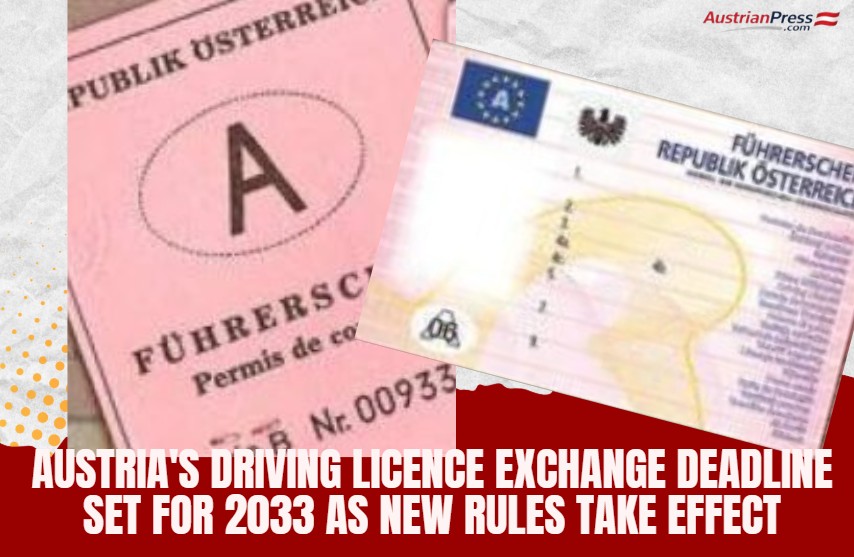
Austria is gradually phasing out older driving licences as part of a Europe-wide standardisation effort. All licences issued before 19 January 2013 must be exchanged for the current EU credit card-style driving licence by 19 January 2033.
The mandatory exchange applies to both traditional pink paper licences and card-format licences issued before the cut-off date. However, motorists do not need to replace their documents immediately. Existing licences generally remain valid until early 2033, provided they are not otherwise invalid, the information remains legible, and the photograph still allows clear identification of the holder.
Who Must Exchange Their Licence?
Unlike Germany, where exchange deadlines are staggered according to age groups, Austria has opted for a single deadline. Every driving licence issued before 19 January 2013 falls under the same requirement and must be replaced by 19 January 2033.
The measure is purely administrative and does not affect a driver’s underlying entitlement to operate a vehicle. Licence holders who choose to exchange their documents before the deadline will receive a driving licence in the current EU format.
Newly issued card licences are generally valid for 15 years. This limitation applies to the document itself and does not automatically affect the holder’s driving entitlement.
Where and How to Exchange a Licence
Applications for licence exchanges can be submitted to Austrian driving licence authorities. In the western province of Vorarlberg, the responsible authorities are the district administrative offices (Bezirkshauptmannschaften).
Applicants typically need to provide their current driving licence, an official photo identification document, and a recent passport photograph. Additional documentation may be required if the applicant has changed their name.
After an application is submitted, the new EU card licence is usually issued or delivered within five to ten days.
New Driving Test Rules Introduced
Separate from the exchange requirement, Austria introduced several changes to driving licence regulations on 1 September 2026 through the country’s 23rd amendment to the Driving Licence Act.
Candidates who fail either the theoretical or practical driving test can now retake the examination after 12 days, compared with the previous waiting period of 14 days. The shorter waiting period does not apply to the AM licence category.
Authorities have also tightened penalties for cheating in theoretical driving tests. The disqualification period has been extended from nine months to 18 months, and penalties can now also be imposed on individuals who organise or facilitate technological cheating.
Other Regulatory Changes
Additional amendments affect professional and older drivers. For holders of Category C and D licences, the regular five-year validity period once again applies from the age of 60, replacing the previous two-year extension arrangement.
The validity of international driving permits issued under the Vienna Convention has also been extended from one year to three years. The one-year validity period remains in place for countries that operate under older international agreements.
Motorists whose driving licence has been lost or stolen are now permitted to continue driving for up to eight weeks with the appropriate confirmation document, compared with the previous limit of four weeks.
Digital EU Driving Licence on the Horizon
Further changes are expected at the European level. A standardised digital EU driving licence is planned for introduction by the end of 2030, allowing drivers to access their licence via smartphone.
Changes are also planned for accompanied driving schemes. From November 2028, an additional EU-wide model is expected to be introduced, although Austria already operates its own L17 programme.
Meanwhile, drivers may gain access to a wider range of alternatively powered vehicles. From November 2027, holders of a standard Category B licence are expected to be allowed to drive certain alternatively powered vehicles weighing up to 4,250 kilograms, subject to specific conditions. The increase will not apply automatically to all electric vehicles.
For owners of older driving licences, however, the key date remains unchanged: 19 January 2033, the final deadline for the compulsory exchange of pre-2013 licences.
- source: vienna.at/picture: canva.com



This post has already been read 44 times!