 0
0
 0
0
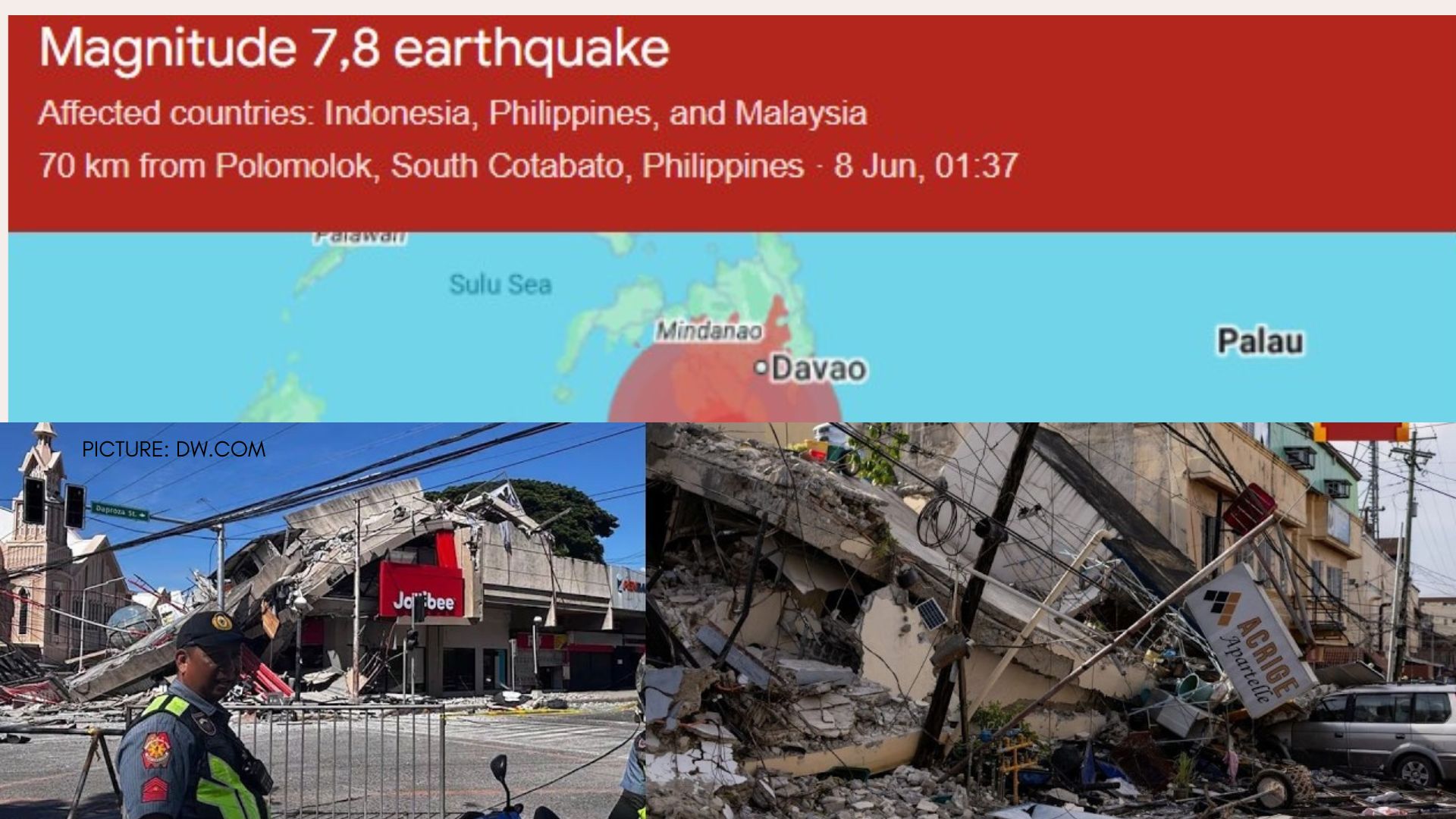
MANILA — A massive earthquake struck the southern Philippines on Monday morning, causing buildings to collapse, claiming at least 15 lives, and triggering tsunami warnings across multiple countries in the region.
According to Rod Sosmena, the Director of Philippine Civil Defense, at least 15 people have been confirmed dead and 129 others were injured. Disaster management agencies noted that official casualty and damage reports are still being actively verified as rescue teams reach affected areas.
The 7.8-magnitude tremor struck at 7:37 AM local time off the coast of Mindanao island, according to the Philippine Institute of Volcanology and Seismology (Phivolcs). The epicenter was located southwest of the municipality of Maasim in Sarangani province.
Tsunami Warnings and Panicked Evacuations
Following the initial rupture, Phivolcs recorded localized tsunami waves reaching heights of up to 1.4 meters (about 4.6 feet) across six coastal zones, prompting authorities to order immediate evacuations to higher ground.
The U.S. Tsunami Warning Center and neighboring Indonesia also issued tsunami alerts. Indonesia’s Meteorological, Climatological, and Geophysical Agency (BMKG) recorded minor sea-level rises along its eastern stations before lifting its warning hours later. Japan similarly cautioned residents along parts of its Pacific coast to stay alert for potential tidal surges, while U.S. geologists registered numerous powerful aftershocks.
President Ferdinand Marcos Jr. addressed the nation, urging coastal residents not to hesitate. “Move to higher ground now. Do not wait,” Marcos said, promising full state support for the affected regions. “The lives of our people are more important than anything they might leave behind.”
Widespread Structural Damage
The shaking was felt most intensely in General Santos City, where the local airport was temporarily shut down to assess runway and terminal integrity.
Videos circulating on social media showed the partial and total collapse of several buildings on Mindanao. Heavy damage has been reported at schools, hospitals, shopping malls, and churches.
“I thought it was my end. I just started praying,” Noreen Ygonia, a local provincial reporter, told media outlets. “It shook so violently that I could barely move.”
“A Blessing in Disguise” on the First Day of School
The earthquake struck on the very first day of the new school year. Because it occurred at 7:37 AM, many schools and government offices were in the middle of outdoor morning flag-raising ceremonies.
Officials note that this timing likely prevented a much higher death toll, as thousands of students, teachers, and employees were already standing safely outside in open courtyards when the shaking began. Classes and non-essential public sector work have been suspended across the region.
In Davao del Sur province, a school building completely collapsed during the tremor. Remarkably, no injuries were reported.
“Fortunately, our flag ceremony was underway, so everyone was outside,” said Principal Elene Marie Jane Gamboa. She added that the building had been previously compromised during a 2019 earthquake and was already slated for demolition.
Ring of Fire
Both the Philippines and Indonesia sit along the Pacific “Ring of Fire”—a vast, horseshoe-shaped belt known for high volcanic and seismic activity. Earthquakes are frequent in the region due to the shifting boundaries of several tectonic plates colliding beneath the ocean floor.
- Hector Pascua/pictures: canva.com/dw.com



This post has already been read 19339 times!